
The Systematic Transfer Plan (STP)
Managing Risk with Your Lump Sum
MUTUAL FUND

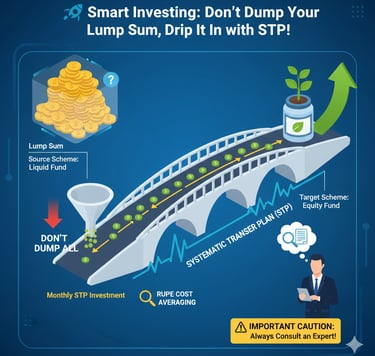
Got a sudden windfall – a bonus, an inheritance, or perhaps some maturity proceeds from an old investment? That's fantastic! But here's the million-dollar question: Should you invest it all at once into the market, or is there a smarter way?
Enter the Systematic Transfer Plan (STP) – your secret weapon for disciplined and less risky mutual fund investing.
What Exactly is a Systematic Transfer Plan (STP)?
Imagine you have a big bucket of water (your lump sum). Instead of pouring it all into a plant (your equity fund) at once, which might overwhelm it or spill if the plant isn't ready, you decide to drip the water slowly, a little bit each day.
That's essentially what an STP does for your money!
It's a facility that allows you to move your money systematically from one mutual fund scheme to another within the same fund house.
Here's the breakdown:
The "Parking Lot" (Source Scheme): You initially invest your lump sum into a relatively safe, low-risk mutual fund. Think of it like a holding tank. Most people choose a Liquid Fund or an Ultra Short Duration Debt Fund for this. Your money is safe here and continues to earn decent, stable returns (usually better than a savings bank account).
The "Growth Engine" (Target Scheme): From this "parking lot," you instruct the fund house to periodically (e.g., monthly, quarterly) transfer a fixed amount into a second, typically higher-risk and potentially higher-return fund, such as an Equity Fund.
This staggered approach helps you navigate market ups and downs much more effectively than a one-time lump sum investment.
Live Example: Meet Maya and Her ₹5 Lakh Bonus!
Let's say Maya just received a fantastic ₹5,00,000 bonus from her company. She wants to invest it for her long-term goals in an equity mutual fund, but she's a bit nervous about the market's current volatility.
Here’s how Maya uses an STP:
Parking the Cash: Maya invests her entire ₹5,00,000 lump sum into a Liquid Fund from ABC Mutual Fund. Her money is safe and starts earning returns from day one.
Setting Up the Drip: She then sets up an STP instruction with ABC Mutual Fund. She decides to transfer ₹25,000 every month for the next 20 months (₹25,000 x 20 = ₹5,00,000) from her Liquid Fund into a Large-Cap Equity Fund (her Target Scheme) within the same ABC Mutual Fund house.
The Monthly Transfer: On a fixed date each month:
Units worth ₹25,000 are redeemed from her Liquid Fund.
This ₹25,000 is then immediately invested into the Large-Cap Equity Fund.
Why This Is Genius: Rupee Cost Averaging!
The magic of STP lies in Rupee Cost Averaging (RCA).
When the market is down (NAV is low): Her fixed ₹25,000 buys more units of the equity fund.
When the market is up (NAV is high): Her fixed ₹25,000 buys fewer units of the equity fund.
Over the 20 months, Maya will have invested her entire ₹5,00,000 into the equity fund at various market levels. This process averages out her purchase cost per unit, reducing the risk of investing all her money at a market peak.
Imagine this scenario:
Month 1: Market is high, ₹25,000 buys 100 units.
Month 2: Market falls, ₹25,000 buys 125 units.
Month 3: Market recovers slightly, ₹25,000 buys 110 units.
By buying more when prices are low, her overall average cost per unit becomes lower than if she had invested the entire ₹5,00,000 when the market was high in Month 1!
🌟 Key Benefits of Using STP
Minimizes Market Timing Risk: You don't have to guess the "best" time to invest your lump sum. STP automates diversification over time.
Harnesses Rupee Cost Averaging: Potentially leads to better returns by averaging out your purchase price.
Keeps Your Money Working: Your lump sum doesn't sit idle in a low-interest savings account. It's earning returns in the source fund until it's transferred.
Promotes Discipline: It's an automated, set-it-and-forget-it strategy that removes emotional decision-making.
⚠️ IMPORTANT CAUTION: Always Consult an Expert!
While STP is a fantastic strategy, it's crucial to be aware of certain aspects:
Tax Implications: Each transfer from your Source Fund is considered a redemption. This might trigger capital gains tax depending on how long you held units in the source fund and the type of fund. For example, if you redeem from a Liquid Fund within 3 years, any gains are added to your income and taxed at your slab rate.
Exit Loads: Some source funds might have a small exit load if you redeem units too soon (e.g., within 7 or 15 days). Ensure your STP frequency avoids these charges.
Scheme Selection: Choosing the right Liquid Fund (source) and the right Equity Fund (target) is paramount. This choice should align with your financial goals, risk tolerance, and investment horizon.
📢 Before you initiate any Systematic Transfer Plan (STP), please remember to consult with a SEBI-registered Financial Advisor or a trusted Mutual Fund Distributor. They can assess your individual financial situation, explain the tax implications, and help you select the most suitable funds for your goals. This blog post is for educational purposes only and should not be considered financial advice..